
Professor Ricardo Henriques: A physicist who fell in love with microscopy
Professor Ricardo Henriques says he has such a deep relationship with microscopes that they are almost a part of his personality. His first passion in the field was old school microscopes, because he could modify and build them as he wished.
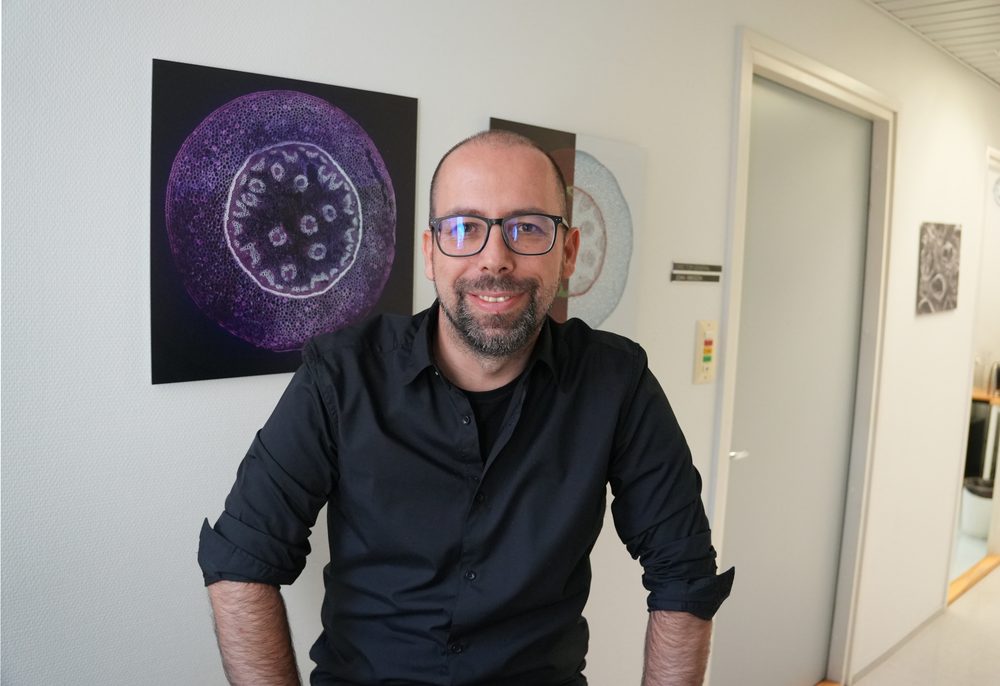
Ricardo Henriques was born in Portugal and trained as a physicist. He decided to become a researcher at a young age, because he was interested in the recurring patterns and regularities that he saw not only in physics, but also in music and mathematics. And even in computer games. Having a relationship with a biologist opened up a whole new world for him.
“I noticed how fascinating it is to apply the principles of physics to biological systems,” he says, pointing out that many of the greatest advances in biology have been inspired by the development of microscopy. The invention of the electron microscope in the 1930s made it possible to see the internal structures of cells and later even individual molecules. Today, fluorescence microscopy, confocal microscopy and super-resolution microscopy have made it possible to monitor the processes of live cells in real time.
Henriques’s path as a researcher has not been the most typical. During his PhD (2008–2011) he split his time between the Instituto de Medicina Molecular in Lisbon, the Pasteur Institute in Paris, CSIR in South Africa, and Andor Technology in Belfast and the United States. He then worked as a postdoctoral researcher at the Pasteur Institute (2011–2013).
“Back then, I found it stressful and inconvenient to move from one place to another, but now afterwards I can say that it was a unique and fantastic time in my life. I gained a lot of experience and training and understood that new things can only arise if I go to my discomfort zone, because that is where science is. If you only use the tried and tested protocols and always think you know what you’re doing, you might not find it!”
From London to Lisbon
Henriques founded his own research team at University College London in 2013 and received a full professorship in 2019. From 2017 to 2020 he also ran a satellite laboratory at the Francis Crick Institute in London. In 2020 he moved his laboratory to Portugal, first to the Instituto Gulbenkian de Ciência and, in 2024, to the Instituto de Tecnologia Química e Biológica António Xavier (ITQB NOVA), Universidade NOVA de Lisboa. Today, he leads the AI-driven Optical Biology laboratory at ITQB NOVA and is an Honorary Professor at University College London.
Henriques has made significant contributions to the development of imaging, and he has often been at the forefront of a highly competitive field. For example, Henriques has developed the Super-Resolution Radial Fluctuations (SRRF) method, which can be used to compute super-resolution images from standard fluorescence microscope images. His group has also developed many other open-source methods for super-resolution fluorescence microscopy and bioimage analysis, such as NanoJ and ZeroCostDL4Mic.
The group’s work is truly multidisciplinary. It combines biophysics and cell biology and applies them to viral infection dynamics, host–pathogen interactions and the immunological synapse. Artificial intelligence and deep learning are central to the work.
Henriques still finds it inspiring to make and build things himself, and he says that in science there is no time to wait for new innovations to move to commercial production so that one could buy the necessary device in a shop.
Henriques is a visiting professor at the InFLAMES flagship and has visited Turku several times. He likes the atmosphere of BioCity and the unique touch each company operating in the building adds to it. He describes the imaging infrastructure of Turku as astonishingly sophisticated. He does not spare his praise when talking about his cooperation with Guillaume Jacquemet, Professor at Åbo Akademi University.
“Our cooperation has been defining for my career and disruptive for the development of the field,” he says.
text: Liisa Koivula